How to Paint More Freely and Trust Your Instincts
Introduction
There’s a moment in almost every painting process where hesitation appears.
You’re about to make a mark, and something in you pauses.
Should I do this?
Will it ruin the painting?
Is this too much?
So you adjust. You soften. You hold back. You override your first hunch.
And often, that’s exactly where the painting loses its energy.
The Women Who Didn’t Hold Back
The women of Abstract Expressionism approached painting differently.
Artists like Lee Krasner, Joan Mitchell, and Helen Frankenthaler were not waiting for certainty before they painted.
They worked with movement, instinct, and emotional intensity.
Grace Hartigan moved between abstraction and figuration without asking permission.
Hedda Sterne stood among the most recognized artists of her time. Yet followed her own, quieter path.
They didn’t eliminate doubt.
They painted through it.
Why This Still Matters Today
Even now, many painters, beginners and experienced alike, struggle with:
- overthinking each step
- wanting to get it “right”
- hesitating before making a bold mark
- losing spontaneity in the process
In other words, we interrupt ourselves.
Abstract painting can feel difficult not because it lacks structure, but because it asks for something else:
Trust.
Abstract Painting as a Practice of Trust
To paint abstractly is not just to “paint differently.”
It is to:
- respond instead of plan
- allow something unexpected
- work without fully knowing the outcome
- stay present rather than controlling every step
This is exactly what made the work of these women so powerful.
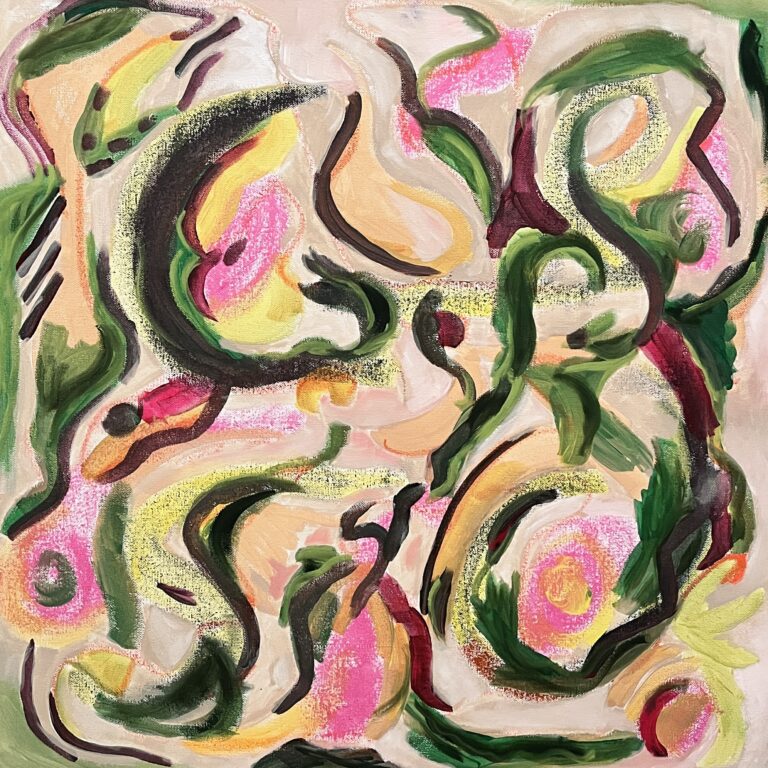
Their paintings feel alive because they are not over-resolved.
They are in motion.
Try This Simple Exercise
If you want to experience this shift, try this:
Take a piece of paper.
Make one mark. It might feel slightly uncomfortable,
a bit larger, darker, or more expressive than you would normally make.
PAUSE
Notice what you feel, respond to that mark.
Not by correcting it,
but by adding something that relates to it.
This is the beginning of intuitive painting.
A Different Way to Learn Abstract Painting
In my Women of Abstraction online class, we don’t focus on copying these artists.
Instead, we use their work as an entry point:
- to explore intuitive mark-making
- to work with color as emotion
- to build layers without overthinking
- to develop trust in your own visual language
This is not about doing it “right.”
It’s about discovering what becomes possible when you stop holding back.
Closing
The question is not:
Can I paint like them?
The question is:
What might happen
if I trusted my own instincts more?
👉 [Join the Women of Abstraction class] Thu April 23-May 28; 1-3:30pm