Many people come to abstract painting later in life not because they missed their chance, but because they are finally ready.
Ready to slow down.
Ready to listen differently.
Ready to make something without needing it to be perfect, useful, or explained.
There is often a moment when the familiar ways of living begin to shift. The need to please softens. The roles that once defined everyday life begin to loosen. And something quieter starts to surface underneath it all.
A question that is not always spoken, but deeply felt:
What about me?
Abstract painting as a different kind of beginning
Abstract painting does not ask you to copy what you see.
It asks you to respond.
With color.
With movement.
With instinct.
With attention to what is present, even if it does not yet have a name.
For many adults, this is surprisingly liberating. There is no fixed outcome you must achieve. No correct image to reproduce. No single way it “should” look.
Instead, there is space.
Space to explore.
Space to experiment.
Space to let something emerge that does not come from expectation, but from experience.
Why later in life can be the right time
There is a quiet misunderstanding that creativity belongs to the young.
But in practice, many people discover something quite different.
Later in life often brings:
a deeper sense of self
less pressure to perform
more willingness to let go of control
and a clearer sense of what feels meaningful
In that sense, abstract painting is not a return to something lost.
It is often a return to something that was never fully allowed.
Learning from the women of abstraction
The history of abstract painting is filled with women who followed their own paths, often outside of recognition at the time.
Artists such as Joan Mitchell, Lee Krasner, Hilma af Klint, and Pat Passlof remind us that artistic voice does not follow a single timeline or rule.
Some were overlooked for decades.
Some worked in isolation.
Some were only fully recognized much later.
Yet their work continues to shape how we understand abstraction today.
These are some of the voices that inspire my own teaching in the Women of Abstraction Series , a set of studio explorations that bring together art history, painting practice, and personal discovery.
When painting becomes a way of listening
In the studio, something often shifts.
People arrive thinking they need to “learn how to paint abstractly.”
But over time, the focus changes.
It becomes less about technique and more about attention.
Less about control and more about response.
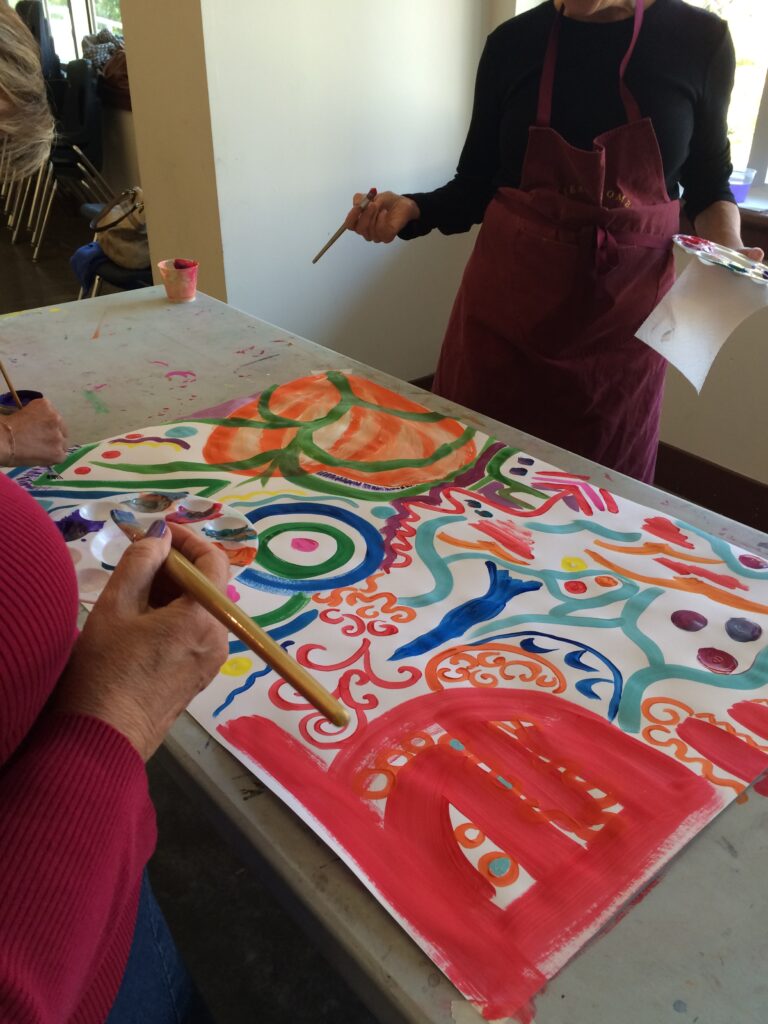
Less about doing it right and more about being present with what is unfolding.
A mark on the page.
A change in color.
A moment of hesitation.
A sudden sense of recognition.
This is where painting begins to feel less like performance, and more like conversation.
A different kind of creative space
Alongside my studio classes, I also offer a Soul Retreat Weekend, a small, immersive space to step away from daily life and return to a slower way of working.
There, the emphasis is not on producing finished work, but on reconnecting with process, intuition, and presence.
Many people describe it as a reset, not only for painting, but for how they relate to themselves creatively.
It is not too late
Perhaps the most important thing to say is this:
It is not too late.
Not to begin.
Not to return.
Not to explore something that has been quietly waiting.
Sometimes the timing is not early or late at all.
Sometimes it is simply right.
Explore further
If this speaks to you, you are warmly invited to explore:
- The Women of Abstraction Series,
- studio explorations combining painting, art history, and creative discovery
- The Soul Retreat Weekend, a slower, immersive space for reconnection and creative presence
You can find both on my website.